
Beyond the Labyrinth: An Intuitive Journey Through the Fes Medina
I’ll be honest: fifteen minutes into the Fes Medina, I wanted to turn around.
The city felt like a physical weight. It was a riot of cedar smoke, the metallic clink-clink of brass hammers, and the smell of raw leather that seemed to stick to the back of my throat. I was holding David’s hand so tight my knuckles were white. We had come to Morocco for "magic," but standing in a 9,000-street maze with a thousand years of history screaming at me, I just felt small. And lost.
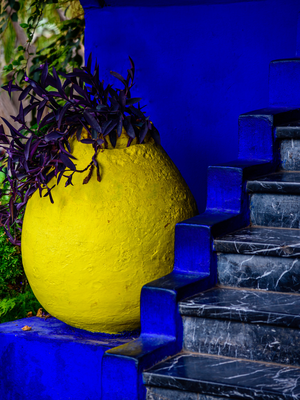
Then, our guide stopped. We were in a passage so narrow we had to walk single file, the stone walls cool against my shoulders. He didn't point at a monument or a shop. He just tapped on a plain, salt-etched blue door. No sign. No golden handles. Just a heavy iron knocker and the sound of the city breathing behind us.
When the door opened, the world vanished.
The roar of 150,000 people didn't just fade; it died. We stepped into a courtyard where the only sound was a single stream of water hitting a marble basin. The air smelled like orange blossoms and old books. We sat on the floor, our legs crossing over zellige tiles that felt like cool silk, and someone placed a pigeon pastilla dusted with cinnamon in front of us.
I found myself crying. It wasn't because of the beauty, exactly. It was the relief. I looked at David, and for the first time in months, I didn't see the "travel partner" I was navigating a map with. I saw him.
I realized then that the "method" wasn't about showing us the famous sites. It was about finding the "eye" of the storm—the one place quiet enough for us to finally hear each other again. That blue door wasn't just an entrance to a house; it was a window back to ourselves. We walked out of that labyrinth hours later, but we weren't lost anymore.